Devpost
Participate in our public hackathons
Devpost for Teams
Access your company's private hackathons
Grow your developer ecosystem and promote your platform
Drive innovation, collaboration, and retention within your organization
By use case
Blog
Insights into hackathon planning and participation
Customer stories
Inspiration from peers and other industry leaders
Planning guides
Best practices for planning online and in-person hackathons
Webinars & events
Upcoming events and on-demand recordings
Help desk
Common questions and support documentation
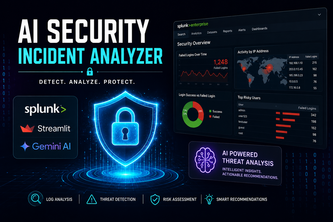
AI-powered cybersecurity dashboard using Splunk, Streamlit, and Gemini AI to analyze security logs, detect threats, identify risky users/IPs, and generate actionable recommendations.
An agentic platform using Graph Attention Networks & Splunk MCP to map third-party vendor connections, scoring risk and hunting lateral supply chain threats in real-time.
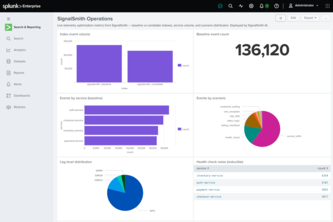
Splunk bills get loud. Alerts must stay loud. SignalSmith cuts noisy ingest with multi-agent shadow proof, then exports deployable OTel config after you approve.
Autonomous SOC analyst on Splunk: it triages, investigates via the official Splunk MCP Server, decides threat vs noise, and acts — only behind a hard human-approval gate.
"Turning 45 minutes of manual triage into 45 seconds of automated resolution." Cut SOC triage by 90%. Splunk AI translates payloads, auto-maps blast radius, & delivers 1-click response playbooks.
AI-powered incident response that transforms Splunk alerts into root causes, timelines, and actionable remediation.
Predicting Policy. Simulating Society
Stop chasing ghosts. AlertFatigue uses AI to tell your SOC which alerts are real threats and which are just noise, then writes the suppression rules for you.
Bilingual AI agent that helps Indonesian citizens detect personal data breaches, powered by Splunk
breach-bot is an autonomous security pipeline: Claude analyzes Splunk logs, detects brute-force attacks, and auto-opens a GitHub PR + Slack alert.
WHISPER predicts system failures 15-60 min before they happen using Splunk MCP, zero-shot forecasting, and Gemini AI. Fix it before it breaks.
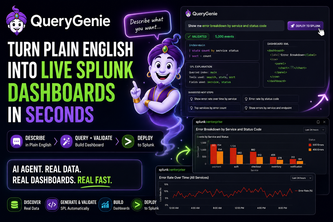
Talk to your data: instantly generate Splunk dashboards from natural language.
The payment layer for the machine economy
AI-driven attack detection for Splunk ES. Layered behavioral detection mechanisms, a triage agent, and a human-in-the-loop investigation loop. Validated against synthetic AI-attack data.
PRISM predicts production failures using Cisco CDTSM + Splunk MCP, investigates root causes with multi-agent AI, and auto-generates GitHub fix PRs — resolving incidents before users are impacted.
SRE Agent is a native Splunk app. It helps SRE, ITOps, NetOps, and SRE teams understand service behavior, detect anomalies earlier, and draft operational response plans from real Splunk evidence.
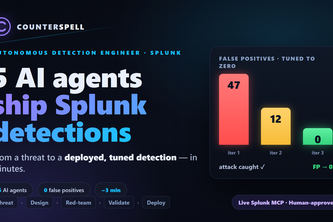
An autonomous detection engineer for Splunk: five AI agents turn a threat into a deployed, tuned detection in minutes.
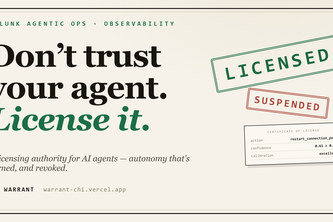
ls measure how smart an AI agent is. Warrant decides how much rope to give it: a per-action license earned by evidence, revoked the moment it's wrong or its model changes.
The flight recorder for agentic operations.
Splunk's AI explains failures; this copilot resolves, validates, and remembers them—self-healing loops from raw logs to AppInspect-green to cost-clean SPL, validated through the Splunk MCP server.
Autonomous, real-time observability and root-cause diagnostics for multi-agent AI systems, powered by Splunk and the Model Context Protocol.
Autonomous threat hunts, fully integrated with the Splunk platform
AI that doesn’t just detect cyber-attacks, it understands them and responds instantly, turning raw security data into autonomous, real-time defense!
Splunk reads 11 agents' eval drift live. An evolver agent proposes PR fixes when drift fires. Stdlib HEC adapter. MIT. Shipped 6 months before Claude Skills became an open standard.
121 – 144 of 315